-
Mr. Gargoyle,
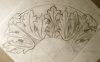
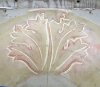
Sculpturing stone is a fantastic art. I noticed in the elevation drawing the leaves have greater articulation than the apparent cutting marks, I feel like you are just getting warmed up. It is obviously difficult to show others with chalk reference marks the three dimensional image you create in your mind. It is probably even more of a mystery to many that with such simple marks your hands will find the sculpture in the stone. How high will the section be when installed?
Bob
-
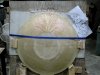
It's going about eye level, behind a low hedge, so people will generally view it either from 5 feet back or from the street, about 25 feet back. It's going in a niche, so no one will be able to see the back side, but it still will be fully carved on all sides.
-
Just an update, I'm still slowly digging my way through this project. The stone has beautiful color and tone, but it has a lot of issues that cause me to have to work slowly and carefully- dry seams (open veins where the stone on both sides isn't fully bonded together), shell and fossil inclusions that can pop out, very soft crumbly areas.
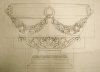
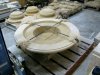
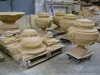
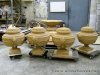
There are a total of 9 urns- eight of one design (four are about 22" diameter, four about 24" diameter) and the big one, 5' diameter, is the one I discussed earlier in this thread.
Urns-four-done-s2.jpg Urns-four-done-s.jpg
-
-
Indeed, Walter,
This is a major project, and it appears that the results are excellent. I shall infer that the discontinuities in the stone can be a major headache for a carver, notwithstanding the marvel that the skeletons of prehistoric life forms are popping out of the stone, indeed being a part of it. This is not usually a problem for metal engravers who are at least blessed with homogenous materials ( but not always!).
I am so glad you are a member of this forum. You add a fascinating point of view, and there is plenty of overlap in the cusp.
best
Rod
-
Are the seems fr the stone being laminated? Or are they naturally occurring?
Very cool project, by the way.
-
Wooow... Cool project. Thank you for showing us pictures of it.
//DQ
"It's terrorism when it's done by even you and me."
-
The seams are natural veins in the block. Some run with the bedding planes (the natural strata of the rock- think of the stata you see when a highway is cut through a cliff edge) but there are also some that are perpendicular to the bedding planes, so those are settlement fractures.
Austin-large-urn-bottom-middle.jpg
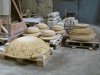
Here's how I received the stone from France:
french-limestone-delivery.jpgfrench-limestone-delivery-2.jpg
-
Walter,
Thanks for keeping us posted on this project. Your work is extraordinary. I expect that you are the "go to" person for ornamental stone carving in the USA. What amazes me is how you can duplicate the same carving on several objects. Can you briefly explain how you do that?
Thanks,
Roger
-
i work in argillite.. on bigger works must contend with quartz?? veins
i feel you pain..
tho i love the idea of encountering prehistoric shellfish in the work
-
If you want shells in the stone, go with the stuff from Green River Stone. They quarry material with lots of big fossils, split it to expose the fossil, and then clean it up to make it stand out.
Check the link for about/laboratory to see how they do it. I've always wanted to use a large slab of their stone in a fireplace, haven't had the chance.
For carving I want consistent, reliable, predictable stone.
Posting Permissions
- You may not post new threads
- You may not post replies
- You may not post attachments
- You may not edit your posts
Forum Rules
|
|