

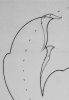
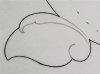
Our first cutting and shading exercise was a big hit and we all learned a lot as we watched each other's approach to the same pattern. Mitch Moschetti accepted my invitation to create this month's exercise, and it's going to be a good one! One of my favorite styles of all time is arabesque, and this beautiful set of leaves is often seen in that style. Thanks again, Mitch! I'm anxious to see the results of this one

Download the .EPS file here.
=====================
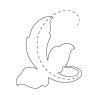
So many enjoyed tweaking Sam's design in the first of this series, I decided to incorporate that into the second. This round will be an intentional Design, Cutting, & Shading Exercise. You'll not only be allowed to play with the structure of the basic design, it's a core part of the drill. I've provided a silhouette of what some call an "Angel Wing*" leaf form that is typically used as the main element in "Arabesque" or "Running Leaf & Vine" type scroll. In one permutation or another, recognizable versions of it have been used by engravers for at least the last couple centuries. While it's likely a scion of the ancient acanthus leaf (and perhaps a bit of oak leaf & others) and can occasionally be found in other media, it has evolved into a form engravers can almost uniquely call our own. It is an inarguable fact that metal engravers, especially those who practice our art & craft on weaponry, have elevated this relatively simple figure into a complex, richly detailed ornamental motif, lush with depth and movement (yeah, I'm a fan...). If you aspire to master Arabesque/Running Leaf & Vine scroll, this humble organic form is where it all begins.
To give you a solid foundation, the main components, curves & proportions have been worked out so you can focus on the details. It's drawn as a fairly generic outline that can be adjusted to suit your vision of what the finished piece should be. The main 'spine' is included to show the central line of balance. This is pretty close to a 'universal' pattern, with the exception that the main body narrows & extends down to form an integral stem. This is my personal preference, while most engravers bring the 'wings' closer together and attach a separate stem or vine. By all means, please feel free to modify ANY & ALL of the elements, or any minor or major part thereof, to suit your own taste & skills. Color outside the lines. A big objective of this exercise is to encourage everyone to develop their own unique style. Just a few basic suggestions are included to give an idea of how to use this, while trying not to unduly influence anyone in any particular direction.
Please note there is no specific size or scale. It could be pretty tiny (<0.5"/12mm), such as might be used as just one of many relatively simple leaves in an elaborate vine pattern, or could be as big as 1.25"-1.5"(30-40mm) and featured as the main element in its own right. My personal preference is for simpler layouts featuring intricately detailed, opulently shaded leaves, as opposed to complexly intertwined designs with simpler individual leaves, but each has its charms. I strongly encourage you to experiment with multiple approaches and post all the results.
As a final suggestion, there is no rule regarding how to execute these in metal. This style of ornament is well-suited to traditional line shading from ultra-fine to quite bold, dots/bulino, as well as virtually any level of relief sculpting. Some engravers simply inlay the basic blank silhouette, then employ a very simple concave bright-cutting technique for a nice decorative look. There are literally an infinite variety of ways to complete this design, so we expect to see some very creative contributions- let your imagination run wild! I recommend printing a pile of copies and keeping some wherever you might have time to doodle- while you're on the phone, watching TV, etc.
I'm honored to be included in this worthwhile project and hope all of you enjoy working with it as much as I enjoyed setting it up. Thanks for playing our game!
*If you don't get the 'Angel Wing' reference, look at the figure upside down.